

Palm Shortening
Palm Shortening
trans fat free!

What is Palm Shortening?
Palm shortening is derived from palm oil (read about Virgin Palm Oil here).
In its natural state, palm oil is a mixture of saturated and unsaturated fatty acids, with most of the unsaturated fat being monounsaturated fat.
Palm shortening is palm oil that has some of its unsaturated fats removed, giving it a very firm texture, and high melting point. The melting point of our Palm Shortening is 97 degrees F., making it very shelf stable. It is NOT hydrogenized, and contains NO trans fats!
It is great for deep-fat frying and baking, and is not prone to rancidity. Since it has been separated from some of the unsaturated portion of the oil, it is colorless and odorless, and will not affect the taste of foods like Virgin Palm Oil does.
If taste is needed in applications, then Virgin Coconut Oil or Extra Virgin Olive Oil can be added for great baked or fried foods!
(Read the history of Palm Oil here.)
Palm Oil: The Number 1 Dietary Oil for the Rest of the World
Although scarcely used in the US any longer, palm oil is the most heavily consumed dietary oil in the world after soybean oil.
If one were to exclude the US where most of the world’s soybean oil is consumed, palm oil would be the most popular dietary oil in the world.
Palm oil traditionally has been used for baking, shortenings, margarines and deep fat frying, as it is shelf stable with a high melting point and does NOT require hydrogenation. Therefore, it contains no trans fatty acids.
Saturated fats, such as tropical oils like palm and coconut, as well as butter, have traditionally been considered healthy fats and oils. In modern history, commercial interests have condemned saturated fats and replaced them in the American diet with polyunsaturated fats that are hydrogenised and contain trans fatty acids, which most people now consider harmful. These trans fatty acids were banned in some European countries as early as 2004, and food label laws in the US just forced manufacturers to list trans fats in their products in recent years. Some cities in the US are now banning trans fats in restaurants as well.
To read research on palm oil and saturated fats, as well as the history of fats and oils click here.
Tropical Traditions Palm Shortening - Sourced from Eco-friendly traditional Farms
Tropical Traditions Palm Shortening comes from small scale family farms in South America.
These farmers are certified by ProForest, which ensures that they meet strict social, environmental and technical criteria. With regard to environmental criteria, the assessments are carried out at the landscape and operational level at both the farms and processing facilities. These assessments cover environmental impact on the soil, water, air, biodiversity and local communities.
The lands the farmers use are not lands that were deforested. The lands used to grow the palm fruit are lands previously used for agricultural purposes (cattle, rice, banana).
In addition, we test each batch for the presence of the herbicide glyphosate.
To order Virgin Palm Oil click here.
Customer Comment:
I don't know how I found Tropical Traditions but I'm glad I did. I have been a chef and deeply involved in natural, organic, high quality food for decades and am deeply impressed by Tropical Traditions' quality, integrity, product line, how ethically they support the people who make their products, and their customer service. Nik - Sacramento, CA

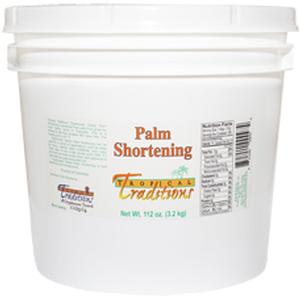
1 Gallon Glyphosate-Tested Palm Shortening - 112 oz.

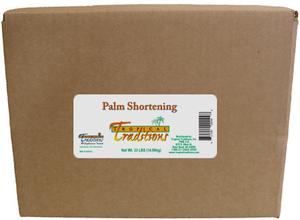
Glyphosate-Tested Palm Shortening - 33 lbs. (limit of 1)