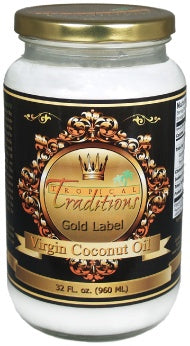
What is Virgin Coconut Oil?
When we first entered the U.S. market back in 2001, there were only two other commercially available coconut oils in the edible oil market, both of them refined coconut oils. We imported the first "virgin coconut oil" from the Philippines to the U.S. that year.
Today, consumers desiring to purchase coconut oil have a wide variety of choices. On this page we will break down the various types of coconut oils currently available in the U.S. market, and define how "virgin coconut oil" is being used in the marketplace, as well as what peer-reviewed scientific studies have discovered in recent years about the different methods of producing virgin coconut oil.
How is Commercial Coconut Oil Produced?
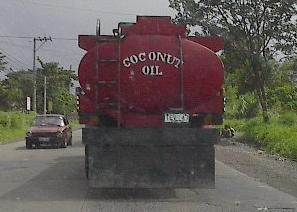
A typical sight on the road in the Philippines:
a truck carrying refined coconut oil.
Refined Coconut Oil
Most commercial grade coconut oils are made from copra. Copra is basically the dried kernel (meat) of the coconut. It can be made by smoke drying, sun drying, or kiln drying, or derivatives or a combination of these three. If standard copra is used as a starting material, the unrefined coconut oil extracted from copra is not suitable for consumption and must be purified, that is refined. This is because the way most copra is dried is not sanitary.
The standard end product made from copra is RBD coconut oil. RBD stands for refined, bleached, and deodorized. Steam is used to deodorize the oil, and the oil is typically filtered through (bleaching) clays to remove impurities. Sodium hydroxide is generally used to remove free fatty acids and prolong shelf life. This is the most common way to mass-produce coconut oil.
The older way of producing refined coconut oil was through physical/mechanical refining (see Tropical Traditions Expeller Pressed Coconut Oil), but more modern methods may also use chemical solvents to extract all the oil from the copra for higher yields.
Hydrogenated Coconut Oil
RBD coconut oil is also sometimes hydrogenated or partially hydrogenated. This happens mostly in tropical climates, since the natural melting point of coconut oil is about 76 degrees F, and already naturally a solid in most colder climates. Since coconut oil is mostly saturated, there is little unsaturated oil left to hydrogenate. Hydrogenated oils contain trans fatty acids.
You are unlikely to find hydrogenated coconut oil as an edible oil in the U.S. market today. It would probably only exist as an ingredient in tropical cultures, in such things as candy bars, where they do not want the coconut oil melting.
Hydrogenated coconut oil is virtually non-existent in the US market, since the FDA started requiring trans fats to be listed on labels several years ago, and is now considering banning them altogether, as some European countries have already done.
Liquid Coconut Oil, MCT Oil, and Fractionated Coconut Oil
Fractionated "coconut oil", sometimes referred to as "MCT Oil" and more recently marketed as "Liquid Coconut Oil," is a refined product derived from coconut oil. In fractionated coconut oil, lauric acid, the primary component and the most valuable part of coconut oil, has been removed by fractionation.
Fractionated "coconut oil" is really only a component of coconut oil, since it does not contain any lauric acid. It remains liquid at a lower temperature. Read more about "Liquid Coconut Oil" here.
Defining Virgin Coconut Oil
There is no industry standard definition for "virgin coconut oil" as there is in the olive oil industry for "virgin" and "extra virgin" olive oil. Today, there are many coconut oils on the market that are labeled as "virgin coconut oil," or "extra virgin coconut oil." Tropical Traditions was the first company to publish standards for the use of "virgin coconut oil" in terms of edible oils 13 years ago.
Today, however, there are many processes used to produce "virgin coconut oil," and no recognized worldwide body that regulates the term or use. There is also no official classification or difference between "virgin coconut oil" and "extra virgin coconut oil" as there is in the olive oil industry, since the two oils are completely different in fatty acid composition, harvesting procedures, and terminology.
So when you see the term "extra virgin coconut oil," it is simply a marketing term, and no different from "virgin coconut oil." We will only use the term "virgin coconut oil" throughout this document. This is also the common term used in the peer-reviewed literature.
So what we will do here is describe each of these processes used to manufacture "virgin coconut oil" for products currently found in the U.S. market, realizing of course that anyone can choose to use the term on a label, even if it is commercially refined coconut oil.
Most all "virgin coconut oils" start out by using fresh coconut meat, or what is called non-copra as we described above in the refined coconut oil section. Chemicals and bleaching clays for filtering are not used, and the deodorization process is also not used in producing virgin coconut oil, since it starts with fresh coconut, and not commercial "copra.”
How is Virgin Coconut Oil Produced?
There are two main methods of producing virgin coconut oil:
1. Virgin coconut oil derived from expeller-pressing the oil from dried coconut. In this method, the fresh coconut meat is dried first, and then later the oil is pressed out of the coconut. This method allows for easier mass production of virgin coconut oil. Since the dried coconut (desiccated coconut) industry is well established in coconut producing countries, many of these industries have added virgin coconut oil to their product line. This is the most common type of "virgin" or "extra virgin" coconut oil that you will find online and in stores today. It is mass-produced. (see our Green Label Virgin Coconut Oil)
2. Virgin coconut oil derived through a "wet-milling" process. With this method, the oil is extracted from fresh coconut meat without drying first. "Coconut milk" is expressed first by pressing it out of the wet coconut meat. The oil is then further separated from the water. Methods which can be used to separate the oil from the water include boiling, fermentation, refrigeration, enzymes and mechanical centrifuge (see our Gold Label Virgin Coconut Oil). So which wet-milling process produces the highest quality virgin coconut oil?
Wet-milling and Heated vs. Unheated Virgin Coconut Oils
The Fermentation MethodWhen we first decided to produce and export a truly unrefined virgin coconut oil from the Philippines to the U.S. market, we visited the top agricultural university in the Philippines and discussed the various methods of producing an unrefined coconut oil with their top scientists familiar with coconut oil production.
We examined the centrifuge, enzyme extraction, and refrigeration methods. In the end, however, we decided to stick with the traditional method of producing coconut oil through the fermentation process. This is a wet-milling process that is very low tech, and can be accomplished by small-scale producers.
The wet-milling fermentation method grates the fresh coconut, expresses the coconut milk, and then separates the oil overnight by allowing the heavier water to fall to the bottom of the container, while the lighter, crystal clear oil, remains on top. Coconut "curds" also form from coconut solids.
The top part containing the coconut oil and coconut solids is then scooped out and put into a large "wok," and the oil is heated for a short time until the curds fall to the bottom. Because the oil is constantly stirred during this time, it does not reach boiling point, but it allows the coconut solids to fall to the bottom. The oil is then filtered and ready to be bottled. The product was a huge success!
There were no other virgin coconut oils in the edible oil market at the time we first brought this product to the U.S. in 2001, and the early success of the product overwhelmed us. We were training more and more people how to produce this wonderful oil, providing jobs to many people.
Unheated and "Cold Pressed" Virgin Coconut Oil
As with any successful new product, soon others began to produce and market "virgin coconut oil" in the Philippines. Most of the products were for the Philippine local market, as the product was gaining popularity in the Philippines also, due to the success in the U.S. However, these virgin coconut oils were not produced using the fermentation method.
The fermentation wet-milling process of producing coconut oil, which anyone could do in their own kitchen, was considered the "poor man's" coconut oil - the coconut oil their grandparents used to make before store-bought commercial coconut oils were available. Therefore, it was considered "inferior." It is also labor intensive to produce large quantities.
Looking to the success of the olive oil industry, soon people began to advertise their virgin coconut oil as "cold pressed," or even "extra virgin coconut oil." While some were wet-milled from fresh coconut, they were mass-produced in a single location, using one of the other methods of wet-milling that requires more technology, such as centrifuge, enzyme extraction, or refrigeration-separation.
Each method wanted to claim that their method was superior to all other methods, giving them some distinct advantage. Some big name raw food advocates from the United States even came to the Philippines and taught people that coconut oil should never be heated, as it would destroy essential enzymes above a certain temperature (although what temperature that would be was disputed.)
When some of these "raw" and supposedly unheated coconut oils began to show up in the U.S. market, we asked what the names of these enzymes were that were supposedly in their coconut oils, so we could test for them in a laboratory and verify their claims. We never received a response. (See why one would not want enzymes in their coconut oil anyway here: The Myth of Enzymes and Coconut Oil.)
So in 2005, Professor Vermont P. Dia of the University of the Philippines conducted a study with some of his graduate students to analyze various virgin coconut oils in the Philippine market produced using different methods. Their results were published in December 2005, in The Philippine Agricultural Scientist, Vol. 88 No. 4, pages 462-475.
Their goal was to determine a national standard for virgin coconut oil. They tested several brands in the local market, and produced some virgin coconut oil in their laboratory, all with little or no heat. They found that most of the items typically tested for in coconut oil, such as free fatty acids, moisture levels, etc. were about the same in virgin coconut oils, although a few brands were lower in quality. However, one characteristic they found that was typically higher in virgin coconut oil than refined RBD coconut oil was the amount of antioxidants in virgin coconut oil.
Since our product, produced with heat and using the fermentation method, had not been tested, because it was not in the local market but only exported to the U.S., we decided to send some samples to Professor Dia. Much to everyone's surprise, our traditionally produced virgin coconut oil made by small-scale family producers, who by this time were also USDA certified organic, tested much higher than the local brands produced with no heat!
We reproduced the test several times to make sure the tests were accurate, and sometimes the results showed more than twice the amount of antioxidants in our simple traditionally-made virgin coconut oil than in the local no-heat cold-pressed virgin coconut oils. (See Professor Dia's statement on Mt. Banahaw Health Products virgin coconut oil, sold under the Tropical Traditions brandname, here.)
Research Proves the Traditional Method of Producing Virgin Coconut Oil is Superior
We are very fortunate that in the last few years, the coconut oil producing countries have begun to wake up and not take for granted that the American view on dietary oils, which states that saturated fats are bad and increase cholesterol levels leading to heart disease, is true. They have come to realize that the campaigns against saturated fats and the tropical oils have been largely a political campaign, not a scientific one, and that American research has favored the newer vegetable oils produced since WWII with expeller-pressed technology that favors the hugely subsidized crops of soybeans and corn.
Research over the past several years have shown that their native fats and oils are healthier than the newer expeller-pressed polyunsaturated oils, such as soy and corn oil. These tropical countries have their own universities, professors, laboratories, and research centers, and they have begun to study various coconut oils, particularly their effects on cholesterol levels, since that has been the main point of attack from Western sources.
So what has this research from countries like India, Malaysia, and Sri Lanka, found in respect to the various methods of producing virgin coconut oils? Incredibly, several studies published in the past few years have completely corroborated our original tests with Professor Dia in the Philippines back in 2005, showing that traditional wet-milling processes that employ heat produce the highest levels of antioxidants.
In 2008, a study done in Malaysia and published in the International Journal of Food Science Nutrition reported that the wet-milling fermentation method produced the highest amounts of antioxidants. In 2011, studies conducted in Sri Lanka by Professor Kapila Seneviratne of the University of Kelaniyashowed that traditionally made virgin coconut oils that use heat in the process, even high levels of heat such as boiling the coconut milk to completely separate the oil (a method we do not use), not only does not harm the oil, but actually promotes the antioxidants to become dispersed in the oil: More surprises awaited the research team.
The general impression is that cooking at high temperatures would degrade the quality of the oil. However, it is not applicable since coconut oil is thermally stable, it is learnt. “Fortunately, most of the phenolic anti-oxidants present in coconut oil are also thermally highly stable,” he pointed out, explaining that the reason for a greater composition of anti-oxidants is that simmering for a long time at a high temperature dissolved more anti-oxidants into the oil. (Published in The Sunday Times of Sri Lanka, October 16, 2011 - "Coconut Oil: It's good for your after all," by Kumudini Hettiarachchi and Shaveen Jeewandara)
In 2013, a study that compared “cold extracted virgin coconut oil” (CEVCO) with “hot extracted virgin coconut oil” (HEVCO) and standard refined coconut oil (CCO) was conducted in India, and published in the journal Food Science and Biotechnology. The title of the study is: Hypocholesterimic effects of cold and hot extracted virgin coconut oil (VCO) in comparison to commercial coconut oil: Evidence from a male wistar albino rat model.
This study, like many others, showed that virgin coconut oils actually lower LDL cholesterol, while raising the "good" HDL cholesterol. This study also confirmed that virgin coconut oil produced with heat produced the highest amounts of antioxidants: "The antioxidant activity in the HEVCO group was 80-87%, 65-70% in CEVCO, and 35-45% in CCO."
The researchers went on to comment why heat is necessary to produce the highest amounts of antioxidants in virgin coconut oil: "The increased polyphenol level in the HEVCO group may be due to increased release of bound polyphenols by heating. Coconut milk is an emulsion of oil and water that is stabilized by protein.
To recover the oil from coconut milk, the protein bond has to be broken by heat in a double walled boiler known as a VCO cooker (steam jacket vessel developed by Central Plantation Crops Research Institute) under slow heating to allow the protein to coagulate and release the oil."
Hypocholesterimic effects of cold and hot extracted virgin coconut oil (VCO) in comparison to commercial coconut oil: Evidence from a male wistar albino rat model Food Science and Biotechnology December 2013, Volume 22, Issue 6, pp 1501-1508 So virgin coconut oils produced by wet-milling and being marketed as "no heat" or "raw" or "cold-pressed" are actually virgin coconut oils with lower levels of antioxidants, according to this body of research.
The Gold Label® Standard Virgin Coconut Oil
Tropical Traditions Gold Label standard virgin coconut oil is produced using the traditional wet-milling low-tech method called fermentation, as described above. This is a traditional method of coconut oil extraction that has been used in the Philippines for hundreds, if not thousands of years.
Marianita Jader Shilhavy's parents generation made coconut oil this way, but the knowledge was in the process of passing away before the founders of Tropical Traditions revived it, due to the easily obtained refined coconut oils found in the stores in the Philippines.
It is a much more labor-intensive method of producing coconut oil, and cannot be replicated by machine through mass-production. Family producers in the rural areas of the Philippines make the Gold Label standard in small batches.
Watch this video to see how Gold Label Virgin Coconut Oil is produced!
This oil is not mass-produced, but made by hand just as it has been done for hundreds of years. The coconuts are certified organic according to strict USDA standards. In addition, all of the coconuts are hand-picked within 24-48 hours of harvest. Only those nuts that produce the highest quality coconut oil are chosen, while the rest of the crop is sold to copra dealers.
Because of the extremely selective procedure for choosing the coconuts, a higher price is paid to the farmer. Almost all other virgin coconut oils on the market are mass-produced and do not take this kind of attention to detail that begins with choosing the right nuts. Also, the coconuts used to make our Virgin Coconut Oil are grown in very rural areas, generally far away from metropolitan areas. Since coconut trees grow just about everywhere in the Philippines, most coconut oils on the market are harvested from trees in metropolitan areas, because there is less cost to transport them to the place of manufacture.
In spite of the success and growth worldwide of this unique product, we still produce our Gold Label Virgin Coconut Oil by hand in small batches by family micro enterprises. Most of them have been producing Virgin Coconut oil for over 13 years now. They have learned what it takes to produce the highest quality oil, such as how to hand pick the best coconuts from each harvest.
One of their discoveries occurred in 2007 when certain groups in rural areas had problems with water sources. Water is needed to make the coconut milk from which the oil is extracted. Using true Filipino ingenuity, they started collecting and using the pure nutritious coconut water from inside the organic coconuts instead. They noticed that the water separated from the oil much quicker, and that less filtering was needed.
The end result was a higher quality and better tasting Virgin Coconut Oil. Independent laboratory analysis shows that this new method produces even higher levels of antioxidants than first tested in 2006 by Professor Dia! So now all of our virgin coconut oil producers use the pure coconut water from their coconuts instead of boiled or purified tap water. This enhanced virgin coconut oil, with the highest levels of antioxidants, is now our Gold Label Virgin Coconut Oil.
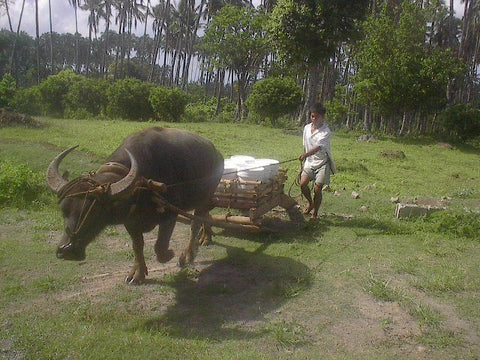
Delivering Virgin Coconut Oil to the Philippine warehouse in 5-gallon pails. Many of our producers live in rural areas in coconut-producing communities where no roads exist, and draft animals like the water buffalo are used.

Bringing in young coconuts from the farm and loaded onto a jeepney to be transported to the market.
I love Tropical Traditions Virgin Coconut Oil, it is the best I have tried, and I will continue to use this oil forever. Kelly - Lander, WY